
Traffic Escape!
FOMO GAMESPuzzle
4.625.21K Reviews
- Version
- 5.5.2
- Installs
- 10.00M
- Age Rating
- Everyone
Screenshots
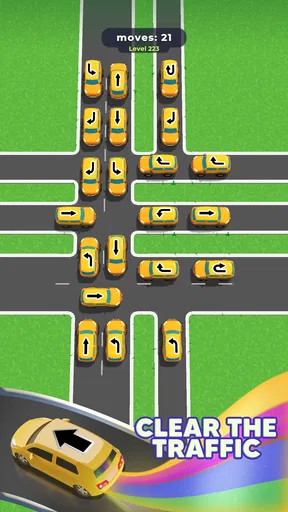
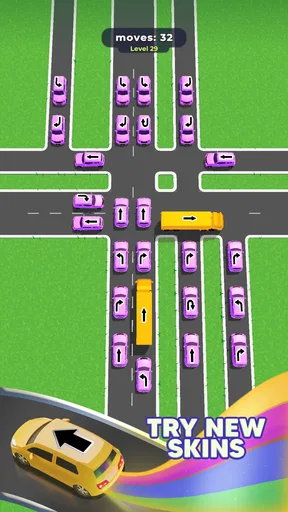
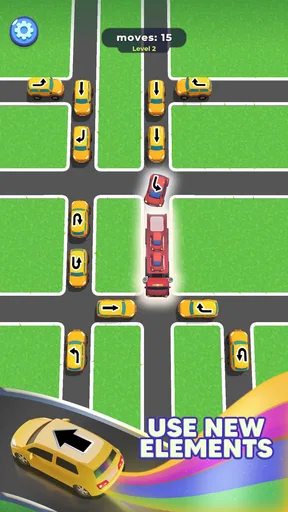
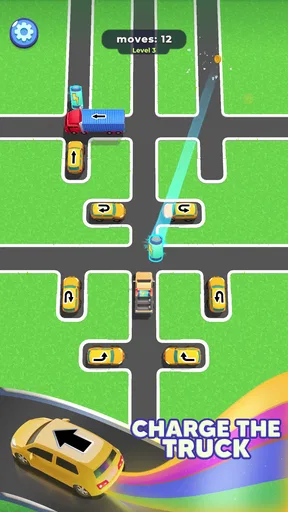


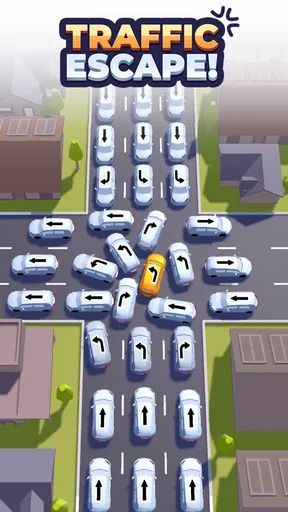
Our Review of Traffic Escape!
 Analysis by Appyee
I spent time with Traffic Escape! as a quick, tap-driven puzzle game, and my first impression was easy to understand: it turns a crowded road into a small logic problem. Cars are packed into a traffic layout, and I tap vehicles so they can leave in the correct direction without creating a worse blockage. The idea is simple enough to grasp immediately, but the later decisions ask for more care than the short store summary suggests.
That simplicity is the main reason I can imagine recommending it to a friend. It works well when I want a short distraction rather than a long story, a complicated control scheme, or a game that demands a large uninterrupted session. At the same time, its focused design means it will not satisfy everyone. If you want deep strategy, a strong narrative, or a puzzle system that keeps changing dramatically, you may find the experience repetitive.
How the traffic puzzles work in practice
The central task is to clear vehicles from a jam by tapping them. A car can only move when its path is open, so every tap is also a decision about what the remaining vehicles will need later. The satisfying part is recognizing a safe sequence before committing to it. A move that looks helpful at first can leave another vehicle trapped or force you to rethink the entire order.
I found the best way to approach a crowded board was to stop treating the cars as separate taps. Instead, I looked for groups: vehicles that shared a direction, cars blocking an exit route, and pieces that could be removed without affecting the rest of the layout. That small change in perspective makes the game feel more like planning than reflex play.
The controls are deliberately direct. There is no complicated movement system to learn, and the basic interaction is suitable for someone who has not played mobile puzzle games recently. That makes it approachable for casual players and younger users, especially because the content rating is Everyone. Still, an easy control scheme does not make every board easy. The challenge comes from choosing the order, not from operating the game.
One useful habit is to pause before tapping the first available vehicle. I often scan the whole traffic pattern, identify the most constrained car, and then work backward. If one vehicle has only one realistic route, it deserves attention before a car with several possible exits. This is a practical technique that saves unnecessary mistakes and gives the puzzle a more deliberate rhythm.
A good fit for short breaks
Traffic Escape! fits naturally into moments such as waiting for a bus, taking a short break from work, or winding down before bed. I can open it, solve a board, and put it away without needing to remember a complicated plot or manage a large collection of resources. That makes it different from puzzle games built around long sessions or extensive progression screens.
Its short-session appeal is also its main limitation. If I am looking for a game to occupy an entire evening, the repeated traffic-clearing format can begin to feel narrow. The game has a clear identity, but it stays close to that identity rather than constantly introducing unrelated mechanics. Players who enjoy mastering one compact system may appreciate that focus; players who need frequent novelty may not.
A realistic everyday use case is a five-minute waiting period when I do not want to start a larger game. I can focus on the immediate board, make a few careful taps, and stop without feeling that I have abandoned a team, missed a timed event, or interrupted a story scene. That low commitment is more valuable than it sounds, particularly for people who prefer games that respect irregular schedules.
What makes the puzzles more interesting than tapping randomly
The most important distinction between a clean solution and a messy one is usually the order of removal. I learned to check whether a vehicle is actually free to move or merely appears free because the first part of its route is open. Looking at the complete path helps avoid spending a move that blocks a more important lane.
Another useful approach is to preserve flexibility. When two cars can move, I generally choose the one that opens more space while leaving the other available as a backup. Removing a vehicle is not automatically progress if the move closes the only useful route for another piece. The strongest decisions often create two or three future options instead of solving only the immediate obstruction.
I also recommend resisting the urge to clear the easiest-looking cars first. Those vehicles can be tempting because they provide instant visual progress, but they may not be the pieces causing the real congestion. A car positioned behind a chain of blockers can be the key to opening the board, even if it is not the first one that catches the eye.
These observations are not hidden buttons or complicated secret systems; they are ways of reading the board more effectively. They matter because the game’s appeal depends on whether the player sees meaningful choices. If you tap without looking, the experience can feel random. If you study the layout, the same simple controls support a more thoughtful puzzle loop.
Free access, purchases, and what the value really means
The game is free to download and play, which lowers the risk of trying it. That is important here because the core appeal is personal: some players will enjoy arranging traffic immediately, while others will decide within a short session that the format is too repetitive. Free access lets you make that judgment without paying upfront.
There are in-app purchases listed from $0.99 to $119.99 per item. I would treat that range as a reason to review purchase choices carefully rather than as a reason to assume the game is poor value. The free entry point is the clearest value for a casual player, while paid value depends on how much the player wants to spend and what each optional purchase contributes during play.
For me, the sensible approach is to begin with the free experience and decide whether the basic puzzle loop remains enjoyable after repeated sessions. A purchase should solve a specific annoyance or add something I genuinely want, not simply happen because I am stuck or impatient. This is especially relevant in a game where the satisfaction comes from finding the sequence yourself.
The game’s popularity suggests that the format has broad appeal: it has an average rating of 4.6 from around 1.1 million ratings and more than 10 million installs. Those figures do not guarantee that it will match your taste, but they do show that the straightforward traffic-puzzle concept has reached a large audience.
Because it is free, I would not compare its value directly with a premium puzzle game that charges once and avoids optional spending. Those are different propositions. A paid alternative may be better for someone who wants a self-contained experience with a clear one-time cost. This game is more attractive to someone who wants immediate access and is comfortable deciding personally whether optional purchases are worthwhile.
Where the free model helps and where it can affect the experience
The free model makes experimentation easy, but it can also change how I evaluate a session. If progress ever feels slower than the puzzle itself deserves, I become more aware of the surrounding purchase structure. My advice is to separate the two questions: do I enjoy solving the traffic layouts, and do I want to pay for anything beyond that? Enjoying the first does not automatically require the second.
For families, the Everyone rating makes the game easier to consider as a general-audience title, but I would still keep purchase controls in mind on a shared device. The age label describes the content audience; it does not turn optional spending into a non-issue. A parent who wants a simple puzzle for a child should decide in advance whether purchases are allowed.
On the technical side, the current version is 5.5.2 and the minimum operating system is Android 8.0. That makes the compatibility requirement reasonably clear for Android users with older devices. I would check the device’s software version before planning to install it, especially on a phone that has not received updates for a long time.
Strengths, friction, and the alternatives I would choose
The strongest part of Traffic Escape! is the clarity of its main interaction. I do not need to memorize a large rulebook. The board communicates the problem visually, and the solution comes from sequencing. That makes it more immediately approachable than traditional logic games that begin with written instructions, symbols, or abstract grids.
It also has an advantage over match-style puzzle games for players who prefer planning over rapid pattern recognition. I am not primarily searching for identical colors or racing a timer; I am trying to understand how one vehicle’s movement affects the rest of the road. Someone who enjoys spatial organization and step-by-step problem solving may find this more satisfying than a purely reactive alternative.
On the other hand, a match-three game may be a better choice when I want constant visual change, quick chain reactions, or a more energetic pace. A classic sliding-block puzzle may be better when I want a tightly defined board with a very pure logic challenge. Traffic Escape! sits between those styles: it is more concrete and visually readable than an abstract grid, but less varied than games that regularly change their entire rule set.
The main friction is repetition. Once I understand the basic traffic logic, the pleasure depends on the quality and arrangement of each board. If several layouts feel too familiar, my attention drops. This is not a flaw for someone who wants a dependable, low-pressure routine, but it is a real weakness for players who measure value by constant surprise.
Another trade-off is that the game’s simplicity leaves less room for personal expression. I am solving the arrangement presented to me rather than building roads, customizing a city, or designing my own traffic system. If you want management, construction, or open-ended experimentation, this is the wrong kind of traffic game. Its focus is solving a contained puzzle, not controlling a living city.
I would also skip it if I strongly dislike games where a mistake can make me reconsider several earlier taps. The challenge is not physically difficult, but the need to think ahead can become frustrating when I want instant, consequence-free interaction. In that situation, a more relaxed matching game may be a better fit.
Who is likely to get the most from it?
I think the best audience is someone who enjoys compact logic challenges and wants a game that can be understood in seconds. It is particularly suitable for casual players who do not want a long tutorial, people who like visual puzzles, and anyone who enjoys improving their ability to spot dependencies between objects.
It can also work for a parent looking for an accessible puzzle with an Everyone content rating, provided the device’s purchase settings are handled appropriately. The game’s basic premise is easy to explain: move the cars in an order that clears the road. That makes it more approachable than a strategy game that requires learning several systems before the first meaningful decision.
More experienced puzzle players may still enjoy it, but probably for a different reason. They may appreciate optimizing the order, avoiding careless moves, and recognizing recurring patterns. However, a serious puzzle enthusiast who expects increasingly complex rules, deep level editing, or a strong competitive layer should compare it with more specialized alternatives before committing time.
The game is also a reasonable choice for someone with an older Android phone that meets the Android 8.0 requirement and wants a free title rather than an expensive new release. I would not promise identical performance on every device, but the stated minimum gives a useful starting point when checking compatibility.
My verdict after weighing the trade-offs
I recommend Traffic Escape! as a free casual puzzle game with a clear hook and a useful short-session format. Its best moments come from looking at a congested board, identifying the critical vehicle, and finding a sequence that opens the road without wasting flexibility. That small act of planning is more rewarding than the one-tap premise might imply.
I would not recommend it as the only puzzle game for someone who needs constant variety or a richer sense of progression. The traffic-clearing idea is focused, and that focus can become repetitive. I would also be cautious about optional spending: the free version is the right place to test the experience, while the listed purchase range means players should make deliberate choices rather than buying automatically.
FOMO GAMES has built the game around accessibility rather than complexity, and that is both its strongest quality and its clearest boundary. The Everyone rating, free entry, direct controls, and large existing audience make it easy to try. The 4.6 average and broad install count add confidence that the concept works for many people, but they should not replace your own test of whether the boards remain interesting.
My bottom line: try it for the free puzzle loop, keep your spending intentional, and stay if you enjoy planning traffic one decision at a time. For a quick, readable logic game, it delivers enough structure to be worthwhile. For a deep strategy experience or a constantly changing puzzle adventure, I would choose something more specialized instead.
Verdict
Strengths of Traffic Escape!
- Simple swipe controls make the game easy to learn.
- Short levels are ideal for quick gaming sessions.
- Increasing traffic density keeps later stages challenging.
- Bright visuals make cars and road hazards easy to recognize.
- Works well as a casual game for most ages.
Limitations of Traffic Escape!
- Gameplay can feel repetitive after extended play.
- Some levels depend heavily on timing and trial and error.
- Difficulty may increase abruptly in later stages.
- Frequent ads may interrupt the flow between levels.
- Limited strategic depth may not satisfy experienced players.
Similar Picks in This Category
View All
Block Blast!
HungryStudio4.8

Braindom: Brain Games Test
Lahana Game Studio4.6

AMAZE!
CrazyLabs LTD4.6

Sudoku - Classic Sudoku Puzzle
Oakever Games4.7

Art Puzzle - Puzzle Games
Easybrain4.8

Amaze GO!
Oakever Games4.9
Frequently Asked Questions
What is Traffic Escape!?
Traffic Escape! is a casual puzzle game focused on clearing vehicles from crowded roads. You tap or select cars and guide them in the correct direction while avoiding crashes, blocked paths, and timing mistakes. As the levels progress, traffic patterns become more complicated, requiring observation, patience, and quick decisions rather than simple reflexes alone.
How do you play Traffic Escape!?
The basic gameplay is easy to understand: identify which vehicle can move safely, then make the appropriate tap or swipe to send it away from the traffic area. You must usually follow directional limits and clear cars in a logical order. Later stages introduce tighter spaces, more vehicles, and obstacles that make planning each move increasingly important.
Is Traffic Escape! free to download and play?
Traffic Escape! can generally be downloaded and played without an upfront purchase, making it accessible for casual players. However, the experience may include advertisements, optional in-app purchases, or bonuses connected to watching promotional videos. Availability of specific purchases and advertising frequency can vary depending on your device, region, and the version installed.
Does Traffic Escape! require an internet connection?
Many of the game’s core traffic puzzles can usually be enjoyed offline after installation, which is convenient when traveling or when mobile data is unavailable. Nevertheless, an internet connection may be needed for advertisements, cloud-related features, rewards, updates, or in-app purchases. If offline play is important to you, test the game after disabling Wi-Fi and mobile data.
Is Traffic Escape! suitable for children and casual players?
Traffic Escape! is designed to be approachable, with simple controls and short levels that are easy to learn. It can suit children and casual players who enjoy light puzzle challenges, although parents should review the age rating, advertising, and purchase settings before allowing younger users to play. Difficulty may increase considerably as new traffic situations are introduced.
Play our best games!


